Tuesday, April 9, 2013

In the wake of the January 2013 arrests in DuPage County of former Schaumburg undercover officers John Cichy, Matthew Hudak and Terrance O'Brien on charges of criminal drug conspiracy, Cook County prosecutors dismissed charges against 19 defendants whose pending cases involved one or more of the officers.
The case reports provide a glimpse of how the three officers conducted undercover work, intercepting drug deliveries at locations around the suburbs and recruiting new informants.
Advertisement
• John Abel, 22, of Schaumburg. Abel was on parole for a 2009 burglary when he was arrested on March 14, 2012, on charges he intended to deliver hydrocodone, cannabis and mushrooms. His lawyer declined to comment.
• Victor Aguilar-Abazan, 24, of Streamwood. He was picked up on Jan. 4, 2012, after police say he sold a total of 4.1 grams of cocaine to an informant on two separate occasions. In an interview with the Daily Herald, he denied selling drugs. On the day he was arrested at his home, police say they recovered 5.3 grams of cocaine and $1,687. Reports show police released him pending his cooperation in future investigations. He later declined and surrendered to police.
• Mario Alvarez-Romero, 33, of Schaumburg. Alvarez-Romero, known as "Yo," met an informant in a Hoffman Estates parking lot on May 23, 2012, to sell the informant an "eight ball" (3.5 grams of cocaine), police reports show. Police say they recovered 5.25 grams of cocaine. Released pending his cooperation, Alvarez-Romero was arrested at his home on June 8, 2012. A judge issued a bond forfeiture warrant for his arrest on Nov. 13, 2012, after he failed to show up in court. The judge quashed the warrant on Jan. 29, 2013, after prosecutors dismissed the charges against him. He could not be reached for comment.
• Diangelo Beasley, 25, of Chicago. Police reports say Beasley, known as "KP," took a Metra train to Arlington Heights on June 27, 2012, to sell 75 Ecstasy pills and a quarter-ounce of cocaine to an informant. Police reported Beasley, after his arrest, told them the cocaine was fake and that he was just trying to make some extra money and do his friend a favor by selling it. Police reported they recovered 67 Ecstasy pills. Beasley, who court records show was on probation at the time for a 2011 drug conviction, has convictions dating back to 2005 for possession of cannabis and possession of a controlled substance. Beasley's public defender declined to comment.
• Russell Disney, 23, of Palatine. Police reports say Cichy purchased 0.9 grams of cocaine from Disney in a parking lot at a Palatine liquor store on Oct. 11, 2012. Several days later, on Oct. 16, Cichy purchased 1.8 grams of cocaine from Disney, police reported. Since his October 2012 arrest, Disney has completed substance abuse treatment. His lawyer Kathryn Ross says he has been "scared straight," while he says he is taking advantage of his second chance.
• Wendell Galbreth, 37, of Elgin. Charged with delivery of cocaine and reckless driving, Galbreth told his customers to leave money in the glove boxes of their unlocked vehicles, which Galbreth would replace with a half-ounce of crack cocaine, police reports say. On Aug. 8, 2012, an informant made such an arrangement with Galbreth on the 1000 block of Schaumburg Road, according to police. Hudak reported he observed Galbreth place 14.45 grams of cocaine in the glove box, remove the money and attempt to drive off. Galbreth ignored orders to stop and drove across the sidewalk and parkway, nearly striking two officers, police reported. Galbreth surrendered to police several days later. His lawyer did not return calls for comment.
• Alex Garcia, 18, of Palatine. Police reports say Garcia sold cocaine to Cichy on Dec. 18 and Dec. 28, 2012, with the latter transaction for 3.33 grams. Hudak reported he purchased 26 grams of cocaine from Garcia for $1,050 on Jan. 4, 2013. Police arrested Garcia at that time, recovering a large butcher knife from his front pants pocket, police reports indicate. He could not be reached for comment.
• Marleny Gutierrez, 20, of Wheeling. Having obtained a search warrant for Gutierrez's home, officers spotted her leaving her home and getting into a car driven by another person on Jan. 11, 2013, records show. Police stopped the car and detained the driver, who they said had $1,600 in cash. After searching the home, the officers recovered 3.2 grams of cocaine and 16.8 grams of cannabis, police reports say. She could not be reached for comment.
• Caesar Hernandez, 22, of South Beloit, Ill., and Christopher R. Nelson, 28, of Beloit, Wis. Police reports say Hernandez, nicknamed "Monster," agreed to meet a confidential informant at the parking lot of a Schaumburg bar on Aug. 7, 2012, to sell 2.5 ounces of cocaine for $1,300. Officers converged on the car driven by Nelson and retrieved from Hernandez's front pocket a loaded .357 Ruger handgun that had been reported stolen from Janesville, Wis, reports say. Officers recovered a total of 44.08 grams of cocaine from the car, according the the police report. Hernandez, who was on parole for the manufacture and delivery of cocaine at the time, was charged with armed violence. Nelson was wanted on a warrant in Winnebago County at the time of his arrest. Illinois Department of Corrections records indicate Hernandez is in custody. Their lawyers did not respond to a call seeking comment.
• Christopher Koeller, 33, of Arlington Heights. On March 16, 2012, Cichy contacted Koeller, also known as "Lucky," to purchase Ecstasy, and arranged to meet him at a Woodfield Mall restaurant, reports indicate. He arrived in a car driven by another man, who, according to police reports, pushed Hudak in the chest and kicked O'Brien in the groin when Hudak tried to arrest him. Police reported they recovered 20 Ecstasy pills and 9.3 grams of cocaine. Koeller was charged with delivery of Ecstasy. The other man was charged with intent to deliver cocaine, resisting arrest and battery to a police officer. His lawyer said Koeller declined to be interviewed because he has another case pending.
• Raina Lewerenz, 19, of Franklin Park. Lewerenz had two Ecstasy pills at the time of her arrest in November 2012 on possession of a controlled substance charges, court records show. Her lawyer did not return calls seeking comment.
• Xavier Neodina, 30, of Streamwood. Officers obtained a search warrant for Neodina's home where, on Oct. 25, 2012, they recovered 119 grams of heroin and 68 grams of cocaine, report show. Police also recovered a loaded Smith & Wesson AR-15, a loaded .410 caliber handgun, a loaded .22 caliber Ruger and two other handguns, which Neodina's former lawyer Robert Irsuto said were registered to his client, who he said had a firearm owner's identification card. Neodina was charged with possession and intent to deliver cocaine and heroin and armed violence.
• Tommy Phillips, 27, of Elgin. Elgin police charged Phillips with intent to deliver a controlled substance in July 2011 after authorities say they found a bag containing 16.8 grams of cocaine in his car ashtray. Working on a tip from one of the former Schaumburg officers' confidential informants, Elgin police set up a sting that led to Phillips' arrest. Kane County prosecutors dropped the charges against Phillips in January. Phillips could not be reached for comment.
• Efren Rosales, 18, of Palatine. According to court records, police charged Rosales with delivering a total of 28 grams of cocaine on three separate occasions during October 2012. His lawyer did not respond to calls seeking comment.
• Richard Roh, 33, of Lincolnshire. Police charged Roh with possession of cannabis on March 1, 2012, after a confidential informant told them he was to meet with Roh at the Streets of Woodfield to purchase 1 pound of cannabis for $4,300. Reports say officers knew the make and model of the car Roh would be driving and watched as Roh committed a traffic violation for which the officer stopped him. The officer reported detecting a strong odor of cannabis from inside the vehicle. Searching Roh's vehicle, O'Brien found 474 grams of cannabis in a backpack, police reported. Roh was released without charges but later turned himself in after declining to serve as an informant. Roh was charged with possession of cannabis. His background includes probation for thefts in 1999 and 1998 and 18 months special probation for an amended forgery charge from 1997. His lawyer did not return calls seeking comment.
• David Russell. 36, of Elgin. An informant arranged to meet Russell in front of a home improvement store on Nov. 10, 2010, where the informant introduced Hudak, who purchased cocaine from Russell, police reports show. Police recovered a total of 42.5 grams of cocaine, they reported. Russell was released pending his cooperation, but officers subsequently were unable to find him. A judge issued a warrant for his arrest. He was also wanted on a warrant in Chicago. His lawyer reported he has not heard from Russell.
• Robert Thomas, 29, of Hanover Park. On Oct. 2 and 30, 2012, a Cichy and Hudak informant purchased a total of 2.4 grams of cocaine from Thomas at Thomas' home, records show. Police report that on Nov. 1, 2012, officers executed a search warrant and recovered 29 grams of cocaine and 4.4 grams of heroin. Thomas was charged with unlawful possession of heroin and cocaine with intent to deliver. Court records describe Thomas as an "admitted addict." He has another case pending on possession of cannabis. His lawyer said Thomas declined to be interviewed because he fears police reprisal.
• Kyle Wenk, 21, of Elburn. Wenk was charged with unlawful delivery of Ecstasy on May 16, 2012, at Woodfield Mall in Schaumburg. Police report he sold 49 pills to an informant in exchange for $575. Court records show he was arrested on Sept. 26, 2012, in Kane County on a charge of delivery of cannabis. His criminal background includes convictions for possession of cannabis in 2011, DUI in 2010 and delivery of a controlled substance in 2009. His lawyer did not return calls seeking comment.
— Barbara Vitello, bvitello@dailyherald.com

Friday, January 4, 2013

The Electronic Dance Music Phenomenon

(December 2012)
By Katherine Loh

Shifts within the music industry have presented its followers with the 1970s disco movement, heavy metal era of the 1980s, boy band melodies of the 1990s, and transcendence of the hip-hop evolution of the 2000s. However, an upbeat and energetic sound has recently dominated the mainstream media in various ways. America is making a rapid transition into the electronic dance music scene, better known as EDM.

According to Forbes Magazine’s EDM series titled “House Music Has Become a Global Phenomenon”, contributor Dan Schawbel says music trio, Swedish House Mafia was able to sell out New York City’s Madison Square Garden within nine minutes in 2011. Ben Sisario of The New York Times writes that music festivals like Ultra and Electric Daisy Carnival draw crowds of 100,000 or more. Electronic dance music has perpetuated the influx of raves and music festivals worldwide.

Recently, electronic music has received a tremendous amount of radio airplay. Swedish House Mafia is a group of three Swedish music producers that have been active members of the electronic music era since the late 1990s. Their most recent hit “Save the World” has over 55 million views on YouTube and numerous plays on the radio.

The term “EDM” is a fairly new phenomenon. Ryan Mac, contributor for Forbes Magazine’s wealth team, says that electronic dance music has begun to exist in various inclinations.
IMG_2023
“The phrase ‘EDM’ was born only a couple years ago, even though the roots of the dance music were there for decades,” Mac said. “In terms of how big it can be, coming from a strictly financial standpoint, some people are estimating that this whole industry could be worth about four billion dollars per year at some point in the next couple of years.”

But electronic music has been around for decades. Ben Sisario, writer for the New York Times, believes there was a pretty established electronic dance music sound and scene in the mid-eighties.
“In the US, there have been waves of popularity and there have always been raves but they have been fairly small by comparison to what is happening now,” Sisario said.

Large music festivals that strictly play electronic music, also known as raves, have become the center of the EDM movement. In the early 1990s, raves were typically kept underground and much of the public was unaware of its existence. Police officers would frequently break up the secret shows to scan the area for illegal substances. Raves are popularly known for its association with the drug, Ecstasy.

“Even when I started going seven years ago, there would be people that don’t really like this music but went because there are so many good drugs there,” said Jessica Sonabend, 23 year old blogger of The Ranting Raver. “At a rave, I have never seen so many people on drugs in one area before.”
Yet, drug use is common at almost every music festival event. Sisario believes drugs have had an impact on the music scene for many decades.

“Look at Woodstock! I think that drugs have been part of this music scene for a long time,” Sisario said. “On balance, I think it is no different than many kinds of pop music.”

Aside from its associated drug use, the electronic music industry is a big investment. The perpetuation of raves is only one of many sources of cash inflow. Mac says huge amounts of money are being tossed around to grow the industry in relation to venues and tours. Raves are drawing thousands of attendees with its headliner acts and special effects.

“Hundreds and thousands of people go and they have state-of-the-art speakers and lights,” Sonabend said. “You pay good money and you get the most bang for your buck.”
IMG_3288Sonabend has listened to electronic music and attended at least 300 raves since she was 16 years old. Her love for the music began before the existence of social media and Facebook updates.

“When I first started going to raves it was word-of-mouth,” Sonabend said. “There would be like an info line where somebody would turn their phone off and change the voice message on their phone to the location of the rave.”

After attending her first rave, Sonabend couldn’t get enough of it. She liked the thrill of sneaking out of her bedroom window of her parents’ house, feeling like she was up to no good.

However, unlike Sonabend, other attendees like to look at raves and electronic music as a time to relax. For MC Romano, junior at the University of Washington, raves act as mini vacations. After attending the Ultra music festival in Miami, FL, Romano associates the beach setting with her love for the music.

“These shows can be up to two to three days long,” Romano said. “You can do other things such as getting a hotel or camp.”

Another reason many believe electronic music has received mainstream media attention is due to the recent collaborations between EDM producers and hip-hop artists. While some popstars are creating their own remixes of electronic music, DJs like David Guetta have collaborated with Akon and Kid Cudi to produce some of America’s Top 40 singles like “Sexy Chick” and “Memories”.

“Historically, DJs have not been very successful as pop stars and their own records don’t really sell too well to mainstream audiences and it’s still pretty much the case,” Sisario said. “David Guetta became a celebrity in his own right.”

Jensen Wong, junior at the University of Washington, agrees that EDM broke through to the mainstream audience through radio airplay.

“Five years ago you would only hear hip-hop or alternative on the radio,” Jensen said.

The electronic dance music scene has impacted America in a variety of ways that people still struggle to completely understand. Music festivals have given many fans the opportunity to experience a type of music whether or not drug abuse is established. However, its growing industry has helped EDM become a widespread phenomenon.

“People want to experience this thing and in a sense, the industry has to accommodate this growing influx of interest,” Mac said.

(http://festivalfuse.wordpress.com/2012/12/06/the-electronic-dance-music-phenomenon/)

Saturday, December 29, 2012

Electronic Dance Music Growth -- Full Interview!

Below are two things you may find of interest... The first is a blurb by Katherine Loh of festivaluse.wordpress.com regarding a subject she interviewed for her blog, one Ms. Jessica Sonabend. Then, below that is a link to Ms. Loh's blog which takes you to her page with a 4 minute clip of  her interview with... well... check it out below!!


What The "Ranting Raver" Has to Say About the EDM Movement
(December 2012)
By Katherine Loh

Jessica Sonabend, the writer behind “The Ranting Raver” blog publication is currently 23, yet has been attending raves since since she was 16 years old. I thought profiling her involvement within the rave and EDM culture was a great way to get a glimpse of her experience as well as her thoughts on its mainstream appeal.

Sonabend has attributed the growth of the rave scene to many promoters’ work and efforts. These include flyers and social media promotion. In addition, many of her favorite DJs have also gained attention on their own.

“Swedish House Mafia…Steve Angello, Sebastien Ingrosso, and Axwell…those are extremely old-school producers,” Sonabend said. “The fact that they came together in this group and blew America out of the water…people started seeing who they were.”

She states that it is a big deal considering none of these DJs are from the United States. In fact, many of them got their start in Europe and hit it big once they reached America. To her, the new collaborations between hip-hop artists like Nicki Minaj and Flo Rida are distasteful. After listening to a remix done by Flo Rida to the original “Cry” by Bingo Players, Sonabend wished it didn’t have to happen.

“This dude does not know how to produce music,” Sonabend said. “You can’t really do anything about it because EDM has become very mainstream.”
(http://festivalfuse.wordpress.com/2012/11/28/what-the-ranting-raver-has-to-say-about-the-edm-movement/)

Electronic Dance Music Growth -- Full Interview!
(December 2012)
By Katherine Loh

I spoke with a few experts that know a little about the Electronic Dance Music scene. Here is what they had to say about the reasons of its immediate growth:
http://festivalfuse.wordpress.com/2012/12/06/electronic-dance-music-growth/

"Raving" About America's Music Festival Scene!

Looking for a positive spin on this past year instead of the negativity some of the media has given this phenomenon? Read below for the REAL deal...

(December 2012)
By the Ranting Raver

Shifts within the music industry have presented its followers with the 1970s disco movement, heavy metal era of the 1980s, boy band melodies of the 1990s, and transcendence of the hip-hop evolution of the 2000s. However, an upbeat and energetic sound has recently dominated the mainstream media in various ways. America is making a rapid transition into the electronic dance music scene, better known as EDM.

According to Forbes Magazine’s EDM series titled “House Music Has Become a Global Phenomenon”, contributor Dan Schawbel says music trio, Swedish House Mafia was able to sell out New York City’s Madison Square Garden within nine minutes in 2011. Ben Sisario of The New York Times writes that music festivals like Ultra and Electric Daisy Carnival draw crowds of 100,000 or more. Electronic dance music has perpetuated the influx of raves and music festivals worldwide.

IMG_2023Recently, electronic music has received a tremendous amount of radio airplay. Swedish House Mafia is a group of three Swedish music producers that have been active members of the electronic music era since the late 1990s. Their most recent hit “Save the World” has over 55 million views on YouTube and numerous plays on the radio.

The term “EDM” is a fairly new phenomenon. Ryan Mac, contributor for Forbes Magazine’s wealth team, says that electronic dance music has begun to exist in various inclinations.

“The phrase ‘EDM’ was born only a couple years ago, even though the roots of the dance music were there for decades,” Mac said. “In terms of how big it can be, coming from a strictly financial standpoint, some people are estimating that this whole industry could be worth about four billion dollars per year at some point in the next couple of years.”

But electronic music has been around for decades. Ben Sisario, writer for the New York Times, believes there was a pretty established electronic dance music sound and scene in the mid-eighties.
“In the US, there have been waves of popularity and there have always been raves but they have been fairly small by comparison to what is happening now,” Sisario said.

Large music festivals that strictly play electronic music, also known as raves, have become the center of the EDM movement. In the early 1990s, raves were typically kept underground and much of the public was unaware of its existence. Police officers would frequently break up the secret shows to scan the area for illegal substances. Raves are popularly known for its association with the drug, Ecstasy.

“Even when I started going seven years ago, there would be people that don’t really like this music but went because there are so many good drugs there,” said Jessica Sonabend, 23 year old blogger of The Ranting Raver. “At a rave, I have never seen so many people on drugs in one area before.”
Yet, drug use is common at almost every music festival event. Sisario believes drugs have had an impact on the music scene for many decades.

“Look at Woodstock! I think that drugs have been part of this music scene for a long time,” Sisario said. “On balance, I think it is no different than many kinds of pop music.”

Aside from its associated drug use, the electronic music industry is a big investment. The perpetuation of raves is only one of many sources of cash inflow. Mac says huge amounts of money are being tossed around to grow the industry in relation to venues and tours. Raves are drawing thousands of attendees with its headliner acts and special effects.

“Hundreds and thousands of people go and they have state-of-the-art speakers and lights,” Sonabend said. “You pay good money and you get the most bang for your buck.”
IMG_3288
Sonabend has listened to electronic music and attended at least 300 raves since she was 16 years old. Her love for the music began before the existence of social media and Facebook updates.

“When I first started going to raves it was word-of-mouth,” Sonabend said. “There would be like an info line where somebody would turn their phone off and change the voice message on their phone to the location of the rave.”

After attending her first rave, Sonabend couldn’t get enough of it. She liked the thrill of sneaking out of her bedroom window of her parents’ house, feeling like she was up to no good.

However, unlike Sonabend, other attendees like to look at raves and electronic music as a time to relax. For MC Romano, junior at the University of Washington, raves act as mini vacations. After attending the Ultra music festival in Miami, FL, Romano associates the beach setting with her love for the music.

“These shows can be up to two to three days long,” Romano said. “You can do other things such as getting a hotel or camp.”

Another reason many believe electronic music has received mainstream media attention is due to the recent collaborations between EDM producers and hip-hop artists. While some popstars are creating their own remixes of electronic music, DJs like David Guetta have collaborated with Akon and Kid Cudi to produce some of America’s Top 40 singles like “Sexy Chick” and “Memories”.

“Historically, DJs have not been very successful as pop stars and their own records don’t really sell too well to mainstream audiences and it’s still pretty much the case,” Sisario said. “David Guetta became a celebrity in his own right.”

Jensen Wong, junior at the University of Washington, agrees that EDM broke through to the mainstream audience through radio airplay.

“Five years ago you would only hear hip-hop or alternative on the radio,” Jensen said.
The electronic dance music scene has impacted America in a variety of ways that people still struggle to completely understand. Music festivals have given many fans the opportunity to experience a type of music whether or not drug abuse is established. However, its growing industry has helped EDM become a widespread phenomenon.

“People want to experience this thing and in a sense, the industry has to accommodate this growing influx of interest,” Mac said.

(http://festivalfuse.wordpress.com/2012/12/06/the-electronic-dance-music-phenomenon/)

Monday, October 29, 2012

Music Festivals Rake in Millions for Hosting Cities

Don't believe us (but we think you do!)? Read below for the full story...

(October 2012)
By Jessica Sonabend

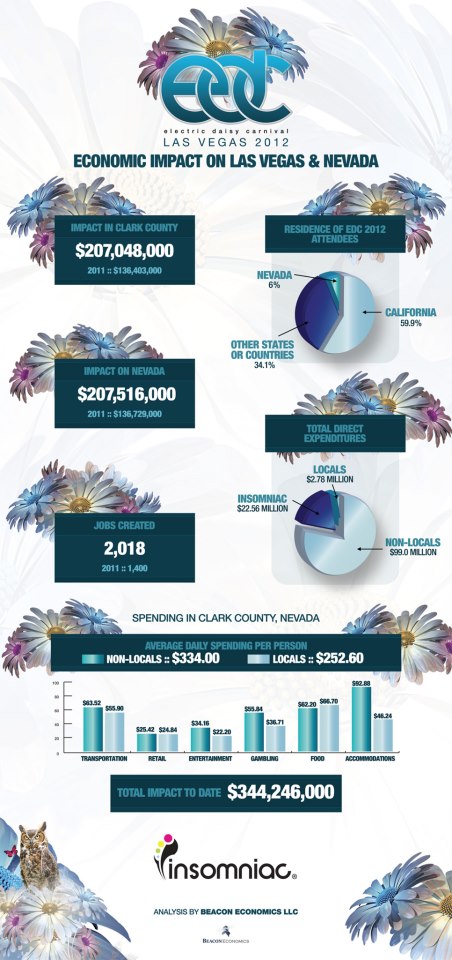
Trashed fields and cluttered arenas are the least of their worries as hotels, retail stores, and entertainment venues in Clark County, Las Vegas count the cash in their pocket after hosting the three-day Electric Daisy Carnival (EDC) at the Las Vegas Motor Speedway.

In June 2012, EDC attracted over 320,000 fans, bringing in a total estimated impact of $34.4 million since its first hosted carnival event in Las Vegas according to the Insomniac News Report. This year, “$28.3 million [was] spent in accommodations, $19.8 million in transportation, $19.6 million in dining, $17.2 million in gaming, $10.5 million in entertainment and $7.9 million in retail.”
With a growing number of fans and anticipated comeback each year, many more cities seem as if they are preparing themselves to host America’s next music festival scene.

Las Vegas is not the only city benefiting from this influx of music shows, but Austin, TX has received a dramatic change in its economy as well.

In March 2012, Austin introduced its annual music industry conference, trade show, and festival known as the South by SouthWest Festival (SXSW). According to the Bizmology Report the 2011 festival to kick off the NCAA conference raked in “$167 million to the local economy during the two weeks of the music, film, and interactive festivals.”

Regardless of location, many of these music festivals seem to do tremendously well in urban areas like downtown Austin and desserts similar to that of Las Vegas. Being within proximity of a major city helps hotels, restaurants and tourist attractions increase their revenue.

Many individuals are discovering new ways to draw a crowd through the source of music festivals similar to SXSW. Students from the University of Texas conducted a study and did research to draw recommendations on how to successfully increase the attendance of large shows which included “a Battle of the Bands, school choir competitions and roving musicians in addition to the Fair’s full line-up of concerts.”

Although government officials make plans to eliminate future raves, cities are profiting and tremendously benefiting from much of the crowds’ spending activity. The economic impact creates new jobs and increased state and federal tax revenue in various locations. The continuous struggle to rescue the unemployed and pay off the nation’s debts could possibly lie in the success of a new music scene.

(http://festivalfuse.wordpress.com/2012/10/05/music-festivals-rakes-in-millions-for-hosting-cities/)

Wednesday, October 17, 2012

Behind the scenes of a first-time music festival, the rewards and perils

While I was not among those in attendance at What The Festival (see below) it did sound like it was going to be (and was) an amazing event for all those who participated. Below is an article where those who helped to put on this amazing festival (this was its first year!) give a little "behind the scenes" perspective of the whole deal. Note: This is a west-coast festival, for those who may be interested to look into WTF for 2013 and years to come. For the full story, read below...

(August 2012)
By Cody Delistraty

Driving along the same path that Meriwether Lewis and William Clark blazed two centuries ago, music festivalgoers headed into Oregon territory seldom explored since then. Upon entrance to the campsite of the What The Festival, a three-day electronic music event, the rural area’s perils became clear when security issued a single piece of advice: watch out for the rattlesnakes.

“It’s not just a walk in the park,” said Peter Clark, director and producer of WTF, as the festival is colloquially called. "It’s a site that’s never been used for a festival so therefore you have to educate people as to what they’re getting into. They’re not just going to (an urban) venue where they don’t have to worry about that.”
Daniel Zetterstrom photo / Fans at the WTF stage during Ghostland Observatory's performance.

Set on a spacious cattle ranch in Tygh Valley, Ore., the weekend of July 28, the What The Festival certainly had its natural dangers, but the allure of languid country days and starry evenings clearly outweighed them. The event ended up selling out. Setting all of that up, however, and for the first time no less, was a complicated affair. Relying on exactly 172 volunteers, the inaugural festival of 3,000 took a grassroots approach that both accommodated its moderate budget and stayed in line with its bohemian feel.

WTF! Is this the Millennial Generation's Woodstock?
Volunteers took photographs for the festival, dealt with public relations and marketing, and worked backstage. A huge team of helpers also distributed posters in a variety of cities, including nearby Portland and Seattle, to promote the first-time event, and they were excited to help out.

“Being on the street team was not only a great way to get the word out,” said 21-year-old WTF volunteer Emily Meltzer, who lives in Seattle. “But it also made me even more excited to be a part of this inaugural festival.”

Clark noted the necessity of volunteers and their unwavering dedication, saying, “They’re the ones that will come out there and do any job and really not give you that much attitude about it.”
Daniel Zetterstrom photo /

There was certainly much to be excited about as volunteers got in to the festival for free, where there was not only music but also yoga, a hookah lounge, interactive art installations, even a mobile spa offering massages and spa treatments. Although the spa seemed slightly gauche, going against the air of beatnik calm that permeated the festival, the rest of the festival’s offerings were right on point.

“We wanted a mature audience. We wanted it to be tasteful, classy, a little bit more upscale,” Clark said. “We didn’t get the kids. We didn’t get the Kandy Ravers and all that sort of thing,” referring to the groups of tweens and teens who attend raves dressed in bright colors, exchanging small trinkets to gesture friendship.

Putting on this outdoor festival takes a far different approach than more urban events, such as Chicago’s Lollapalooza and Pitchfork, Seattle’s Bumbershoot, Miami’s Ultra, or Paris’ Rock en Seine to name a few. One of the most difficult parts is finding a suitable location, but when Peter Clark and his team were approached by the cattle ranch landowners they knew almost immediately this would be the festival’s home. The spaciousness, the relative proximity to Portland, the atmosphere created by the wide sky and surrounding, acoustically complementary cliffs -- WTF had a home.

“I think this feeling really brings something out of people and creates a really amazing flow of energy throughout the event,” noted Matt Dressman, the festival’s marketing director.

Festivalgoers were quick to concur. “There’s just so much natural wonder up here,” said Andrew Oberland, 24, who works at a software company in Portland. “It’s a little hot -- maybe could use a little more shade -- but it’s amazing!”

Neither the heat nor the possible rattlesnakes put a damper on the festival that was, by all accounts, a
success.

“For a first year festival, I think we knocked it out of the park,” said Clark. “Coming away from an event and already looking towards next year -- considering I just got off site yesterday -- is pretty amazing.”

(http://www.nbcnews.com/entertainment/behind-scenes-first-time-music-festival-rewards-perils-928297?franchiseSlug=entertainmentmain)

Saturday, October 13, 2012

How Congress is Interfering with the Music Scene

For the full scoop...Read on...

(October 2012)
By Jessica Sonabend

Remember when Congress decided that raves were harmful to society and were thought to  condone the use of drugs instead of discourage it?

It is fall and legislation concerning this controversial issue is surfacing. Putting aside statistics, let us consider how difficult it has been to control the use of drug paraphernalia in sports stadiums, concert halls, college campuses, and the back-alleys of urban concrete locations. So why has Congress recently decided to push the ban on raves when drug use has been a prevalent issue within the past 50 years? Why now?

Back when the raves were locked underground, it was difficult for society to understand the effects of the music scene. Glow sticks, pacifiers, chilled air-conditioning rooms, and items as crucial as water bottles were suddenly used as a means of promoting the “drug scene”. Ironically, Congress enacted the Crack House Statute as apart of the Anti-Drug Abuse Act of 1986, which in turn created the RAVE Act (Reducing Americans’ Vulnerability to Ecstasy) as a way to control the public’s opportunity to host or promote parties in buildings where they believe foster drug havens.

According to Drug Abuse Warning Network, “Ecstasy mentions in emergency visits grew 1,040 percent between 1994 and 1999″ in this abcnews report. Congress has used the RAVE Act to pinpoint the music scene as a result for the spikes in drug-related emergency visits. While drug-use occurs everyday, many of their efforts are spent in denial of this very idea. 

Historically, the rave culture has been a haven to promote a fun and respectful atmosphere for all its attendees. To say that its promoters encourage the use of drug paraphernalia by overcharging for bottled water is stating that hot-dog vendors at Safeco Field are doing the same. Why has this idea succumb to outrageous claims against this necessity? Water is an essential item in survival and as much as Congress believes otherwise, it has led society to believe their efforts are more focused on blaming this music culture for drug promotion as an easy way out.

Electronic Dance Music(EDM) has worked its way through the mainstream culture and is making it more difficult for legislation to pass due to its increasing popularity. Hip-hop artists like Nicki Minaj and Pitbull have teamed up with some of the most famous EDM djs to collaborate in their efforts to produce good music. So when a culture that has faced so much controversy and hatred weasels its way into the hands of bank-breaking producers, what will Congress have to say about that?

(http://festivalfuse.wordpress.com/2012/10/11/how-congress-is-interfering-with-the-music-scene/)